
CO2 emissions in the boreal zone
Updated: May 2, 2025
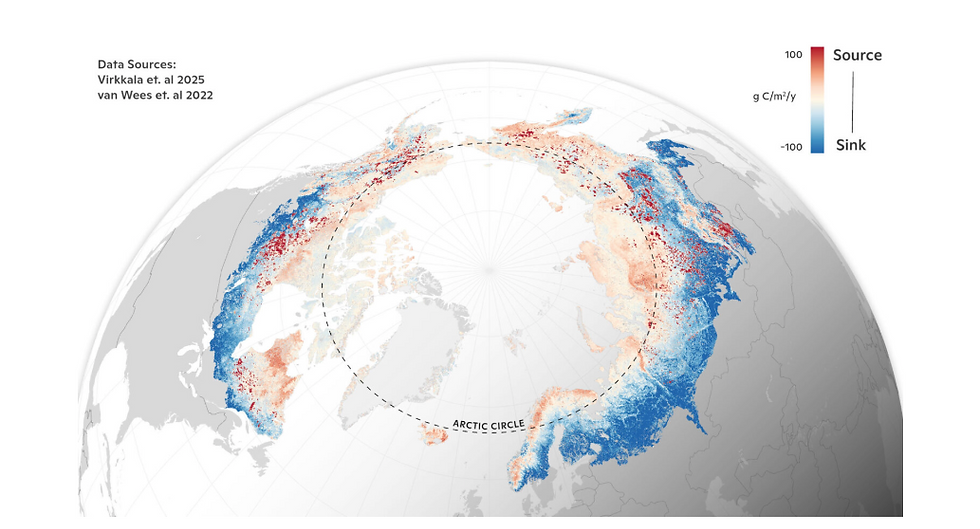
Citation: An international team led by Woodwell Climate Research Center found that a third (34 %) of the Arctic-boreal zone (ABZ)—the treeless tundra, boreal forests, and wetlands that make up Earth’s northern latitudes—is now a source of carbon to the atmosphere. That balance sheet is made up of carbon dioxide (CO₂) uptake from plant photosynthesis and CO₂ released to the atmosphere through microbial and plant respiration. Permafrost has made it clear that a major change is taking place as temperatures rise. Permafrost areas are thawing. The permafrost is now a source of greenhouse gases, primarily methane, which is leaking at an increasing rate. Methane is a very powerful greenhouse gas, but will fade much faster than CO2. This concerns a large area of permafrost that has such high temperatures during the summer months that the permafrost is thawing. This leads to large methane leaks that strongly contribute to the temperature in the atmosphere rising more and more rapidly. Central forskare är Phd. Anna Virkkala. Master of Science, Helsingfors universitet. Woodwell Climate Research Center. For northern Sweden and Finland, Permafrost prevails in a fairly limited area in the far north. Norway has a larger Permafrost area. Some areas, especially in Russia, have also been affected by extensive fires where Permafrost is about to disappear. Which further worsens the balance with greenhouse gases. Summers provide increased photosynthesis in step with higher temperatures, while the increasingly large fellings in the Nordic countries have a negative impact. Forest owners are not content to wait for maximum growth, but large fellings are taking place to make money from their ownership.
Of course there are several factors. Firmly claims that 10 years of summations are needed for climate. Around 2013-2014 there is a clear break in the climate that then prevails.
More meandering large-scale flow pattern. This often leads to long dry periods during summer in central and southern Europe. May also apply to Sweden but still more variable and often a large difference between north and south. The winter months are more likely to be rainy, which is less conducive to tree growth. Drier summers disadvantage tree growth despite. This despite increased CO2 should favor photosynthesis and also increasing temperatures. At the same time, the desired growth does not turn out as hoped. Slightly better green growth above ground is what is achieved, not an improved overall carbon sink. You are destroying life underground by tearing up the land after clear-cutting. The carbon that is bound in the root zone is clearly greater than the green above ground. And it also works all year round. If you had not destroyed it with your cultivation methods, more CO2 could have been bound. And the emission balance could have been improved in the coniferous forest area. A big problem is that people do not realize that harrowing land will lead to a large increase in leakage through waterways to the Baltic Sea. Spruce bark beetle infestation can certainly impair growth somewhat, but not as seriously as the overall effect. You then consider fertilizing, but it is an artificial stimulus, which in the long run impairs the mycorrhizal symbiosis. In pursuit of short-term gains, you have no sense of how living things work. Mycorrhizal fungi provide the real carbon sinks. If you destroy the conditions for root life, forests will no longer be the carbon sinks you take for granted they should be. Countries like Sweden and Finland, with their focus on clear-cutting, end up with forests that are not the carbon sinks you expect. It's something like this below, according to research at Kew Gardens. This may certainly be different in northern Europe. About 20% of total carbon is stored in the aboveground parts of the tree Less than 10% in roots. About 5% in the surface and in dead wood. Almost 75% is found in the soil with the incredible amounts of fine roots of mycorrhiza. Will remain as long as the tree exists. Trees are completely dependent on mycorrhizal fungi, which provide the trees with mineral nutrients. With good mycorrhizal roots, trees can become carbon sinks. If this is destroyed, it takes time to become a good carbon sink again. Something that can never be replaced by scientific methods. Fungi are incredibly important, anything that destroys this is bad for the forest. As I see it, Sweden and Finland must change their forestry. Current methods are not sustainable. Since the forest is so important economically for these countries, they are acting desperately.
Leif Lindblom, Eriksmåla. Swedish Bachelor of arts./Fil. Kand. info@leiflindblom.se


Comments